The story
Twenty jobs.
One app.
We run a commercial construction company in Los Angeles, renovating healthcare facilities for hospital systems. Projects is the software that company runs on. Every screen in it exists because one of those jobs needed it.
The company
Boilers, heat exchangers, emergency showers.
The work is healthcare: clinic renovations, boiler and heat-exchanger replacements, emergency showers, fire-alarm and duct-detector testing — the mechanical and life-safety work a building can't open without. Around twenty jobs open at once. More than seven hundred subcontractors in the book. Our estimates are numbered past 2,200.
A day is an estimate at the desk before seven, a jobwalk at nine, a facilities manager asking where the submittal is by lunch, a change order written in a parking structure, an invoice out before dinner. Twenty of those, side by side. That is the day the software had to survive.
Before
Seven apps and a spreadsheet.
This is what running those jobs used to take. Every one of them billed monthly, and the only thing they shared was an invoice.
Procore and Autodesk
The construction cloud, and the biggest bill in the stack. Pay applications and change orders. We paid to link our clients and architects in; not one of them ever used it. The daily logs were slow enough that the field crew hated filing them, and after all that they still had to be sent by hand.
Asana
Tasks and scope — and the escape hatch. Assigning a sub a simple to-do in the construction cloud took so many clicks that Asana became the place a note or a photo got thrown instead.
Todoist and Notion
Everything that wasn't a job: onboarding, marketing, the side quests.
Dropbox
Plans, specs, and sub quotes.
Word
The long proposals.
QuickBooks
Estimates, invoices, and chasing what we were owed.
Monday
The Gantt. It never looked like something you'd hand a client, and a printed lookahead never came out right — so the lookahead always ended up back in a horrible Excel doc that was miserable to keep current.
Google Sheets
The budget math, by hand. Even paying for the construction cloud, “are we making money on this job?” took so many clicks that the honest answer got rebuilt in a few columns, every time the question came up.
The sub book wasn't in any of them. Phone numbers in contacts, trades from memory. A good sub and a bad sub looked identical on a screen, and “who did we have on that job last spring?” had exactly one search engine — somebody's head. At seven hundred names, that stops working.
What we built
One app, and a short list of things it won't do.
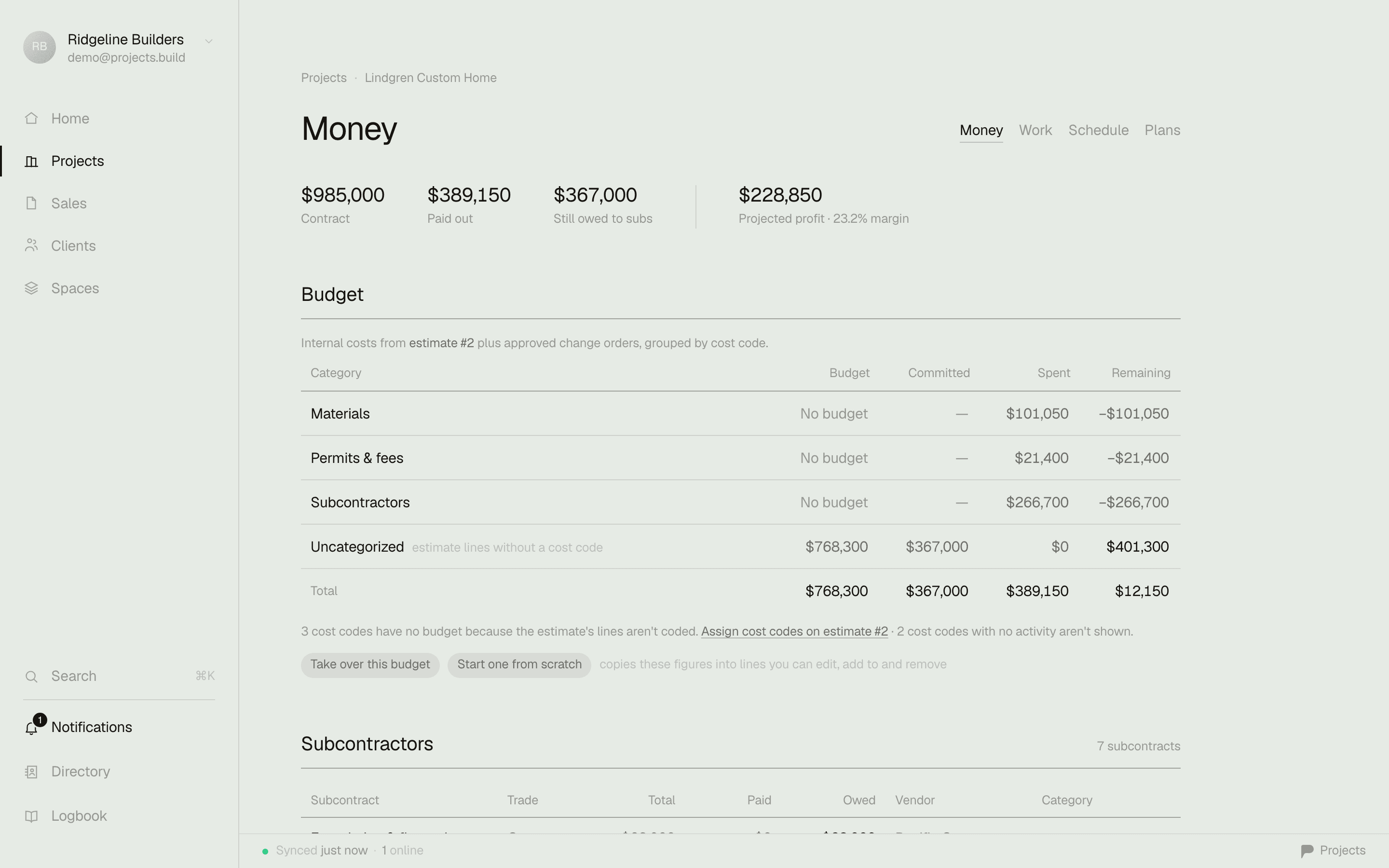
Estimates, change orders, invoices. Budgets that answer the money question on the front page, with nothing to export. Schedules and lookaheads you'd hand a facilities manager without apologizing. A sub book with ratings, notes, and which jobs they've been on, so seven hundred names is an asset instead of a memory test. Spaces for the rest of the business, under the same roof.
And a lot left out, on purpose. Anything that existed to justify an enterprise invoice didn't get built. There is no certification course, no implementation fee, and nothing to configure before the first estimate goes out. The app is light because of what it refuses to be.
The iPhone app isn't a companion to the real one — it is the real one, built native, because the job happens standing up. In a mechanical room with no signal. On a jobwalk with a phone in one hand. In the parking structure, writing the change order before you forget it. The office gets the same thing on a big screen.
Today
The software is new. The company it runs isn't.
Our company runs on Projects every day — every job, every sub, every dollar. When something is slow, or buried two taps too deep, we find out on our own jobs before anyone else does. Then it gets fixed.
So the roadmap isn't a guess about a persona. It's the list of things that got in our way this month. If your work looks anything like ours, you're getting software that had to survive a real day first.